Guide · FSMA 204
FSMA 204 for produce wholesalers: what your warehouse has to record by July 20, 2028
Vonatech Solutions · September 2026 · 7 min read
The Food Traceability Rule does not ask a wholesaler to do anything new to the product. It asks the receiving dock and the shipping dock to write down a fixed set of facts for every lot of a listed food, keep them, and hand the outbound half to the next company. Here is that set, in the order the work happens, and what the FDA can ask you for.
The date, and why it moved
The rule's original compliance date was January 20, 2026. In 2025 the FDA extended it by 30 months, to July 20, 2028, and Congress then directed the agency not to enforce the rule before that date. That is the date to plan against. It is not a date to start on; a wholesaler that first sees its own lot data in the spring of 2028 will spend the summer finding out what its suppliers never sent.
Who and what it covers
The rule applies to persons who manufacture, process, pack, or hold foods on the Food Traceability List. A produce house holds. The list is specific, and the word fresh does the work: an item is covered in the form named, not in every form.
- Cucumbers, fresh
- Herbs, fresh
- Leafy greens, fresh (whole-head cabbage is excluded), and leafy greens, fresh-cut
- Melons, fresh
- Peppers, fresh
- Sprouts, fresh
- Tomatoes, fresh
- Tropical tree fruits, fresh (mango, papaya, guava and the like; bananas, citrus, and avocado are excluded)
- Fruits, fresh-cut, and vegetables other than leafy greens, fresh-cut
The list also carries shell eggs, soft cheeses, nut butters, a set of seafood categories, and refrigerated ready-to-eat deli salads, which matter if your trucks carry them. Everything not on the list is outside the rule. Some exemptions exist for small operations; the FDA rule page links its exemption tools, and the safe assumption for a wholesaler of any size is that the rule applies.
The two events that happen in your building
The rule is written around seven critical tracking events: harvesting, cooling, initial packing, first land-based receiving of seafood, shipping, receiving, and transformation. Each event has its own list of key data elements, and every element must be linked to the traceability lot of the food. A wholesaler that buys packed product and sells it as packed performs two of the seven: receiving and shipping. If you repack, cut, or mix listed produce, you also perform transformation, and the lot you create is yours.
The traceability lot code
The FDA defines the traceability lot code as “a descriptor, often alphanumeric, used to uniquely identify a traceability lot within the records of the firm that assigned the traceability lot code.” It is assigned once, by the initial packer of a raw commodity or by whoever transforms a food, and it rides with the lot from there. You do not assign a new one at receiving, with one exception: product that arrives from a person exempt from the rule with no code on it. Then you assign the code, and your receiving location becomes the code's source.
Two related terms come up in every list. The traceability lot code source is the location that assigned the code. The source reference is an alternative the rule allows, a pointer from which the FDA can identify that location. One or the other travels with the lot.
At the receiving dock: eight things per lot
For each traceability lot of a listed food you receive, the FDA's receiving list is:
- Traceability lot code for the food
- Quantity and unit of measure of the food
- Product description for the food
- Location description for the immediate previous source, other than a transporter. The grower or packer you bought from, not the carrier.
- Location description for where the food was received. Your dock.
- Date you received the food
- Location description for the traceability lot code source, or the source reference
- Reference document type and number. The purchase order, the bill of lading, the invoice: whichever document your record points back to.
Nothing on that list is exotic. What changes is that all eight have to exist for every lot, be tied to that lot rather than to the day's deliveries in general, and be retrievable together. A receiving log that records a truck, a supplier, and a case count has three of the eight.
At the shipping dock: seven things per lot, and you send them on
Shipping is the event where the rule asks you to do two things: keep the records, and provide them to the customer you ship to. The list:
- Traceability lot code for the food
- Quantity and unit of measure of the food
- Product description for the food
- Location description for the immediate subsequent recipient, other than a transporter. The store or distribution center, not the truck.
- Location description for the location you shipped from
- Date you shipped the food
- Location description for the traceability lot code source, or the source reference
- Reference document type and number, which you keep but are not required to send forward
Your customer's receiving record is built from what you send. If the lot code, the quantity, the product description, and the source are on the bill of lading or the invoice that travels with the load, they have what they need and so do you. If the paperwork says “12 cs tomatoes” and the lot lives only on the case label, the chain breaks at their dock, and the FDA will trace it back to yours.
If you repack or cut: a new lot
Transformation is any step that produces a new food from a listed one: repacking, fresh-cutting, mixing lots. For the lots you use, you record the traceability lot code, the product description, and the quantity taken from each lot. For the food you produce, you assign a new traceability lot code and record the location where you transformed it (that location is now the source), the date the transformation was completed, the product description, the quantity and unit, and the reference document. The link between the lots consumed and the lot created is the whole point; it is what lets a recall stop at one pallet instead of a week.
The traceability plan
Every covered business must keep a written traceability plan. For a wholesaler that does not grow, it is four things:
- A description of the procedures you use to maintain the required records, including their format and where they live
- A description of how you identify which foods you handle are on the list
- A description of how you assign traceability lot codes, if you assign any
- A point of contact for questions about the plan and the records
The plan is updated as your practices change, and the previous version is kept for two years after each update. It is a short document, and it is the first thing an inspector will ask to see, because it tells them where to look for everything else.
The 24-hour request
The records must be made available to the FDA within 24 hours of a request, or within a reasonable time the agency has agreed to. During an outbreak, a recall, or another threat to public health, the agency can also require an electronic sortable spreadsheet of the relevant traceability information, on the same clock. That clause is the one that decides how the records get kept. Paper can hold every key data element and still fail the request, because a sortable spreadsheet built from paper is a day of typing, and the day is the deadline. The records have to be data before the phone rings.
What this means on the floor
Put the lists together and the rule reads as one instruction: the lot code must ride, unbroken, from the purchase order to the receiving record, to the label on the pallet, to the pick, to the paperwork on the truck. Every place a wholesaler usually loses it is a place the rule now inspects.
- Receiving that records the truck but not the lot. The lot code, the source, and the reference document need to be captured while the product is still on the dock, when the supplier's paperwork is in hand.
- Relabeling. A house label that replaces the packer's lot code without carrying it forward breaks the source link. Keep the original code on the record even if the pallet gets your own label.
- Picking by product instead of by lot. When two lots of the same item are on the floor, the order has to say which one shipped. Mixed-lot picks need the quantity from each.
- Paperwork that describes the product but not the lot. The bill of lading and the invoice are the reference documents; the lot code belongs on them, per line.
A useful test today, well before 2028: pick any pallet in the cooler and ask for, within ten minutes, who you received it from, on what document, and which customers received cases from it. If the answer takes longer than that, the records exist in people rather than in data.
How Vona records it
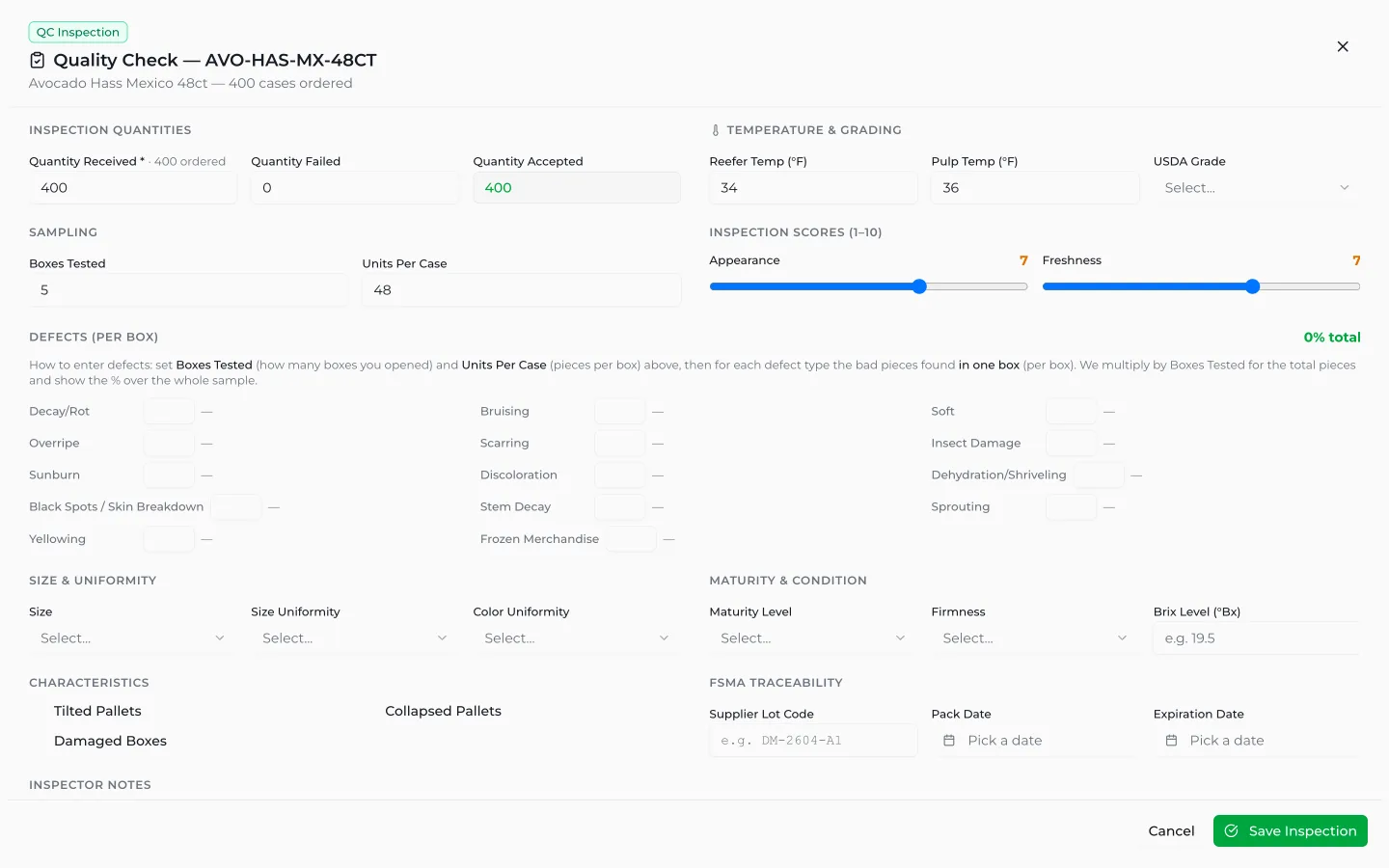
Vona's receiving is built for this rule. A truck checks in against its purchase order by QR, and the dock inspection captures the supplier's lot code and the pack date alongside the temperatures and the grade; nothing from a supplier becomes sellable inventory until a supervisor signs off. Every pallet is stocked as a labeled lot with its origin and cost. An order line that pulls from two lots records both, and the bill of lading rides with the truck. The plan, the point of contact, and the judgment about which of your items are listed remain yours; the data is already data.
Sources
- FDA, FSMA Final Rule on Requirements for Additional Traceability Records for Certain Foods (the rule page: compliance date, who is covered, the 24-hour request)
- FDA, Food Traceability List (the listed foods and their descriptions)
- FDA, Food Traceability Rule: Critical Tracking Events (CTEs) and Key Data Elements (KDEs) (the per-event record lists quoted above)
- Federal Register, Requirements for Additional Traceability Records for Certain Foods: Compliance Date Extension (August 7, 2025)
This guide describes the rule as published by the FDA on the date above; it is not legal advice. Canonical: vonatech.ai/guides/fsma-204-produce-warehouse